

Alumni Highlight - Charles Heller
Monday, February 9, 2026
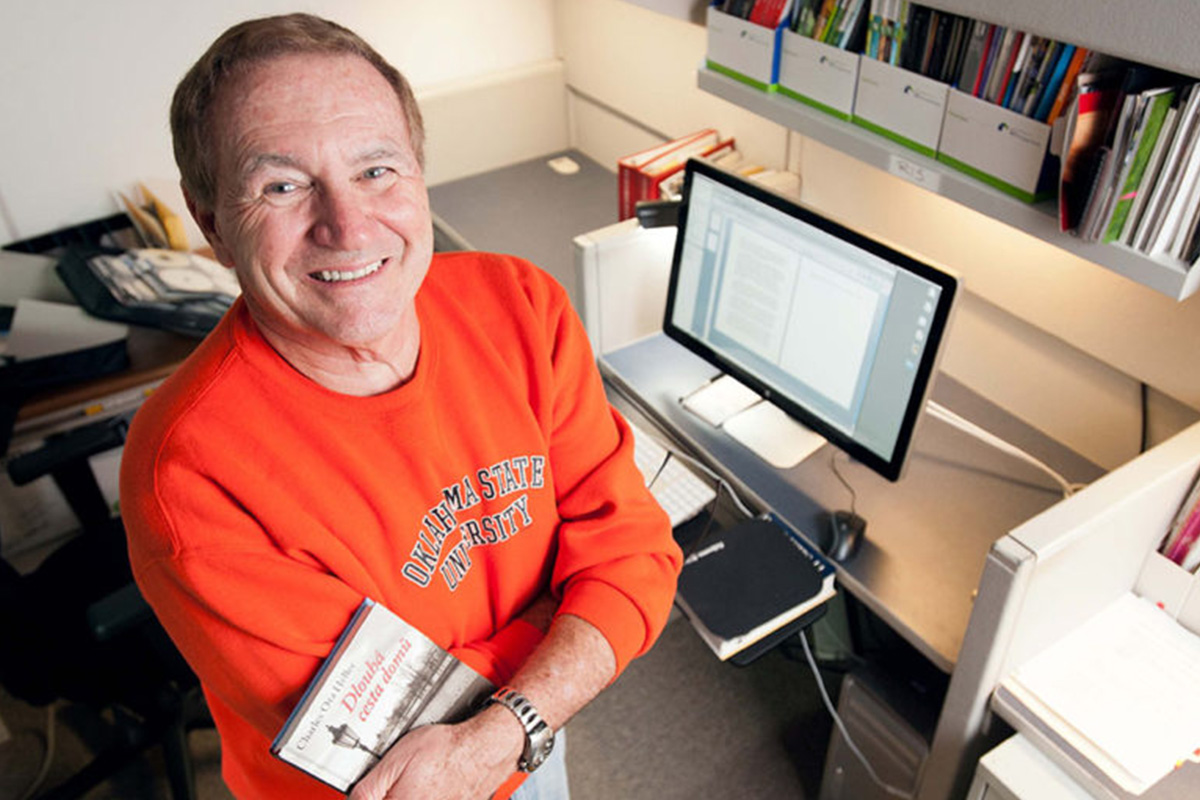
I arrived at Oklahoma State University (then Oklahoma A&M) in September 1954 - a frightened 18-year-old kid. I was 1,500 miles from home, and I knew no one except Professor Jan Tuma and his wife, Hana. A mere five years earlier, I had landed in America, knowing two words of English: “sank you.”
We had spent six days crossing the angry Atlantic in May 1949. While entering New York Harbor, my father aroused me early and brought me up on deck of the Liberty ship to get a first look at a country which would become our new home.
“That’s the Statue of Liberty,” he said. “Remember this moment for the rest of your life. That lady is a symbol of everything your mother and I want for you in America - happiness and freedom to be whatever you want to be.”
I was thirteen years old, and I had yet to realize that I had already experienced more than most people do in a lifetime. I spent the war years hiding out like an animal from the German occupiers of my native country, Czechoslovakia; my father escaped to join the British army, and my mother was imprisoned in a slave labor camp; twenty-five members of our family were murdered in the Holocaust. With the war coming to an end, at the age of nine, I shot a Nazi. After less than three years of freedom, my parents and I left behind friends and nearly all our worldly possessions and survived a harrowing escape from Communist thugs. We spent fifteen miserable months in three refugee camps while awaiting a visa to the United States. It was there that we met the Tumas, fellow Czech exiles. Jan Tuma would go on to head the School of Civil Engineering at OSU.
That first summer in the U.S. was filled with events that took place so rapidly and were so overwhelming that I had little time to stop to contemplate them or to feel sorry for myself. I was told that I would have to change my name. It was determined that Ota Karel Heller would become Charles Ota Heller - a simple reversal of first and middle names and a translation of Karel to Charles. New friends taught me the rudiments of American sports - baseball, basketball, and football. I discovered television. But although I failed to realize it at the time, the most significant moment came when Papa took me aside one evening.
“America is the land of opportunity,” he said solemnly. “But we’re immigrants who are starting from nothing. There’ll be a lot of hurdles in the way, and there’ll be no one around to help you. Here is what I want from you: I want you to forget everything that happened to you on the other side of the Atlantic. I want you to devote all your energies to becoming a 100% American, as fast as you can. You’ll start by learning to speak fluent English. A year from now, I want you to speak without an accent. When you open your mouth, I want people to think you’re a native.”
One did not argue with a European father of that era. One simply saluted smartly and said “yes, sir.” I did not salute, but I did say: “yes, sir,” before Papa continued:
“Don’t ever let anyone tell you that you’re not capable of doing something. Put your head down and go do it! As an immigrant, you’re going to have to outwork everybody you compete with. And, no matter what you do, don’t ever give up!” These words would become my life’s mantra as I set out to chase the proverbial American Dream.
It began in a New Jersey high school, where I did well academically and excelled in sports. And, yes, I spoke without an accent. I turned down three offers of college basketball scholarships because I had read about an amazing coach named Mr. Henry Iba at a place called Oklahoma A&M. I became obsessed with playing for him. Although my dream of becoming a star never materialized, I earned a scholarship and contributed enough hours as a practice player and bench-rider to be able to say proudly:
“I played for Mr. Iba!”
Following a year of assimilation as a freshman civil engineering major, I made a terrible mistake. During summer vacation, I decided that I could not survive another year so far from my girlfriend. Unbeknownst to my parents, I enrolled at Rutgers. After my mother and father finally came to terms with my idiocy, I hit them with another bombshell. I wanted to change my major. This time, the answer was an emphatic “no!” But I would show them. I did not buy any books and my grades went south. By the end of the year, I was in academic purgatory. I was ready to return to OSU. But would the university take me back?
The fact that OSU welcomed me back with open arms and gave me a second chance both shocked me and changed my life. I made up my mind to pay back all those wonderful people in Stillwater - Professor Tuma, Mr. Iba and my friends - by living by my father’s mantra: “to outwork everybody” and to make everyone proud.
I earned my B.S in civil engineering in 1959 and an M.S. a year later. To the amazement of my parents, the CIVEN faculty voted me “Outstanding Graduate.” I married that New Jersey girlfriend, Sue, and we headed west to seek our fortune. I worked in the aerospace industry until I was lured away by Bell Labs in Baltimore, Maryland. While there, I decided that big-company life was not for me and joined the aerospace engineering faculty at the Naval Academy. After receiving my doctorate from The Catholic University of America, I was named the youngest tenured professor in the history of the Naval Academy.
But then the entrepreneur bug bit me, and I co-founded one of the first computer-aided design software companies, CADCOM. I was its CEO until we sold to a larger firm ten years later. My partner and I then applied our CAD technology to publishing, and we founded a company called Intercad. Eventually, I experienced entrepreneurial burnout and moved on and joined the faculty of the University of Maryland, where I spent ten wonderful, satisfying years running the Dingman Center for Entrepreneurship. We assisted hundreds of startups in the region and got many students started on their careers as entrepreneurs.
Seeking new worlds to conquer, I left in 2000 to become a venture capitalist. As partner in two VC firms, I participated in the financing and mentoring of a number of young tech companies in the U.S. and overseas.
Today, even as an octogenarian, the word “retire” does not enter my vocabulary. In addition to sitting on a couple of boards, I write books. My first, Prague: My Long Journey Home, has received a number of awards. My second is titled Name-droppings: Close Encounters with the Famous and Near-Famous and is dedicated to Mr. Iba. My third is called Ready, Fire, Aim! An Immigrant’s Tales of Entrepreneurial Terror, and I am proud to say that former President Hargis is among the dignitaries who endorsed it with blurbs. My most recent book is titled Cowboy from Prague: An Immigrant’s Pursuit of the American Dream. Much of it is devoted to my OSU experiences, and I am grateful to former Dean Paul Tikalsky for having been one of the endorsers of the book.
Sue and I were married for 63 years before she passed away. I live with my partner, Elise, in Annapolis, Maryland, near my son David. I have three grandchildren: Sam, Sarah, and Caroline, and two great-grandchildren, Cole and Max. Over the years, I have been fortunate to be honored with a number of awards and prizes. However, none have brought me more pride and happiness than those bestowed on me by OSU’s College of Engineering, Architecture and Technology: the Lohmann Medal and induction into the CEAT Hall of Fame. I have many reasons for bleeding orange!