

School of Chemical Engineering study could improve speed, efficiency of carbon capture
Monday, October 19, 2026
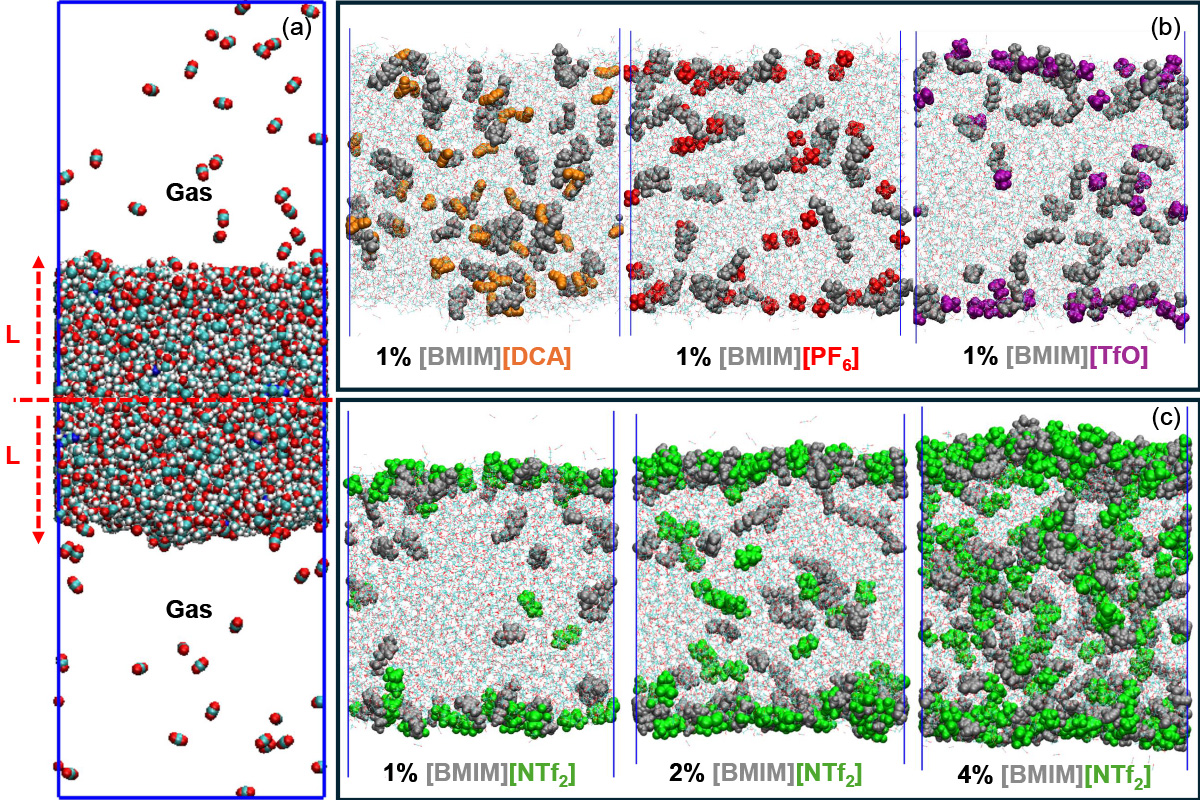
Every second, billions of carbon dioxide molecules are released into the atmosphere from power plants, industrial facilities, vehicles and other sources. Discovering ways to capture these emissions before they enter the atmosphere could play a major role in reducing greenhouse gases, but current systems to capture carbon can be expensive and consume lots of energy.
Researchers in the College of Engineering, Architecture and Technology at Oklahoma State University are studying one of the smallest parts of that process: the molecular interactions that occur when carbon dioxide meets a liquid solvent.
Dr. Jindal Shah of the School of Chemical Engineering was the principal investigator, alongside two former CHE Ph.D. students, Dr. Amey Thorat and Dr. Rashmi Mishra. The team partnered with researchers at the University of Chicago Department of Chemical Engineering on a paper titled, “Ionic Liquid-Enhanced Interfaces to Boost Reactive CO2 Capture,” published in The Journal of Physical Chemistry. The team’s findings could help the design of faster, more efficient and more economical systems to capture carbon. Their work was funded by the U.S. Department of Energy.
The team combined laboratory experiments with molecular simulations to investigate how ionic liquids, a unique class of salts that remain liquid at room temperature, influence the speed at which carbon dioxide is captured. Molecular characteristics were identified that significantly improve carbon capture performance while requiring only a small number of additives.
“We focused on understanding the fundamental physical and chemical processes that drive CO2 capture and how ionic liquids can accelerate those reactions,” Shah said.
The importance of CO2 extends beyond environmental concerns, as it can corrode industrial equipment, impact catalysts used in manufacturing and reduce the amount of energy contained in natural gas.
If captured, CO2 can be a valuable raw material for producing chemicals, plastics, textiles and pharmaceuticals.
“Developing efficient capture processes allows us to use carbon dioxide as a building block for new materials in an energy-efficient and environmentally friendly way,” Shah said. “It’s similar to how plants use carbon dioxide and water during photosynthesis.”
The team studied solvent mixtures of potassium hydroxide, ethylene glycol and ionic liquids. Unlike conventional salts, ionic liquids can be customized by pairing different positively and negatively charged ions. This allows researchers to tailor their properties for specific applications.
“Ionic liquids can absorb large quantities of CO2 almost like a liquid sponge,” Shah said. “Many are also essentially nonvolatile, meaning they don’t readily evaporate into the atmosphere. This means improved safety, reduced environmental risks and minimized material losses.”
There are thousands of different ionic liquid combinations, and finding the right concentration is equally important. Too much ionic liquid can increase the viscosity, raise costs or even reduce performance, while too little ionic liquid may not provide any measurable benefit.
To study these differences, the team focused on the gas-liquid interface, or the microscopic boundary where carbon dioxide molecules first enter the solvent.
“Every CO2 molecule must cross this interface before it can be captured,” Shah said. “While the surface of a single bubble is tiny, industrial systems contain millions of bubbles, creating an enormous area where carbon dioxide transfer can take place.”
The team’s molecular simulations fill the gap in measuring how quickly carbon dioxide is absorbed, as traditional experiments can’t directly measure how molecules arrange themselves at that interface.
“Our experiments measured the overall reaction rates, while the simulations showed what was happening at the molecular level,” Shah said. “Together, they allowed us to explain why different ionic liquids change the speed of carbon capture.”
The team concluded that ionic liquids influence several critical properties at the same time. Some reduce surface tension, increasing the contact between the gas and the liquid. Others increase the amount of carbon dioxide that dissolves into the solvent.
Both effects increase the likelihood that carbon dioxide molecules will react with hydroxide ions and become chemically trapped.
The overall results closely resembled the trends predicted by computer models, giving the team great confidence in their findings. One of the most promising discoveries is that noticeable improvements could be achieved with ionic liquid concentrations as low as 1%.
“Faster reaction rates mean smaller reactor vessels, greater processing capacity, improved efficiency and lower operating costs,” Shah said. “Those are the kinds of improvements needed to make carbon capture practical and economically viable.”
The next step for the researchers is to investigate whether ionic liquids do more than simply improve the transportation of carbon dioxide. Researchers will examine whether ionic fluids act as catalysts that directly accelerate the underlying chemical reactions.
“Understanding those chemical mechanisms will provide an even more complete picture of how ionic liquids function,” Shah said. “Ultimately, our goal is to develop highly efficient solvent systems that make carbon capture a more practical technology for widespread industrial use.”
Through the combination of fundamental science and practical engineering, Shah and his team are developing solutions that reach far beyond the lab. Their work shows how curiosity, collaboration and a commitment to real-world challenges can drive meaningful change.