

Alumni Highlight - Gary Johnson
Thursday, February 26, 2026
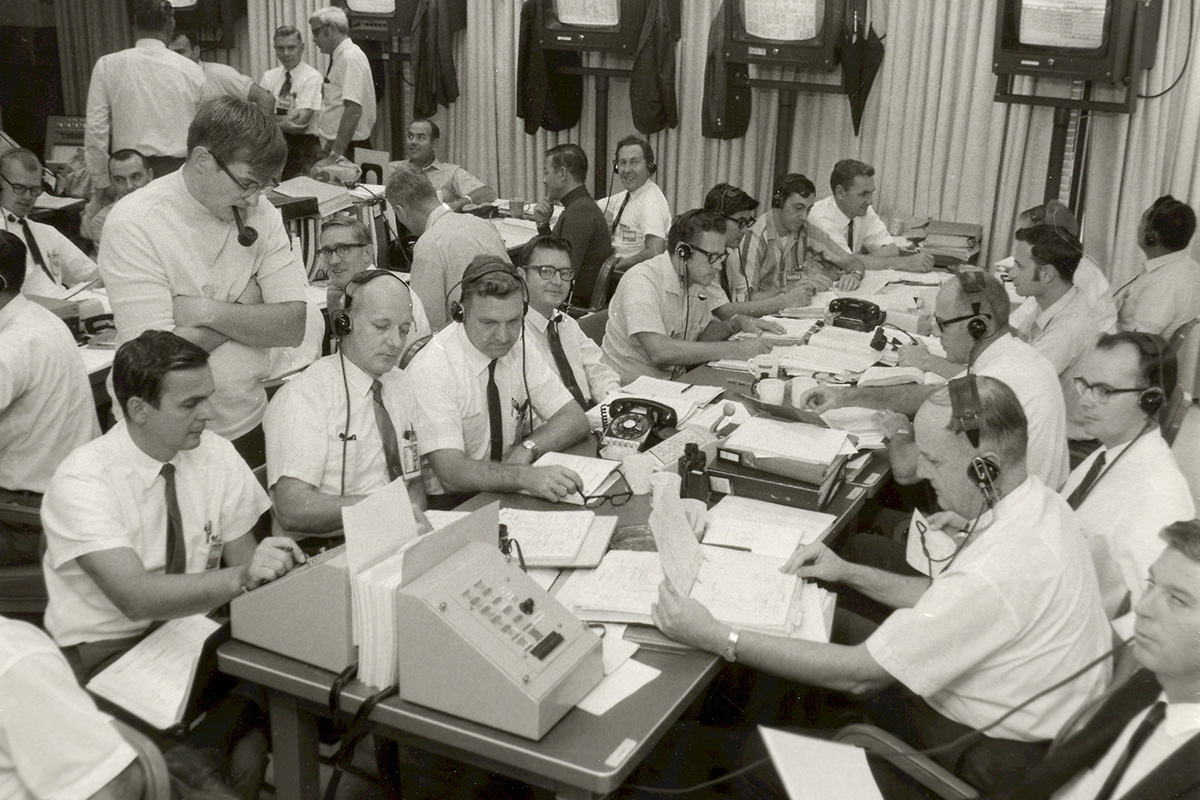
The NASA Mission Evaluation Room during Apollo 11. Gary Johnson can be seen near the end of the left side of the table, wearing a striped shirt. The team monitored the crew and the flight director on the headsets while spacecraft data was displayed on the TV monitors at the ends of the tables.
CEAT alumnus helped power NASA's historic return
When Gary W. Johnson arrived at Oklahoma State University in the fall of 1959, he was enrolled in chemical engineering. But as the nation’s space ambitions accelerated, Gary reconsidered his path. After his junior year, he transferred into electrical engineering, believing it would better position him to contribute to the growing space program.
That decision would shape the course of his career.
Gary graduated in May 1964 and soon accepted a position with NASA at the Manned Spacecraft Center in Houston. Just weeks after commencement, he and his wife, Coe Ann, whom he met on a blind date during his sophomore year, loaded up his Volkswagen Bug and drove south. On June 15, 1964, Gary reported to work as an Apollo command and service module electrical power distribution project engineer.
From the start, he recognized the strength of his preparation.
The College of Engineering, Architecture and Technology’s electrical engineering curriculum had given him exposure to solid-state transistor electronics and Fortran programming on an IBM mainframe computer, experience that was not standard for some of his colleagues' education. That foundation proved critical as NASA transitioned into increasingly complex spacecraft systems during the Apollo era.
Gary supported every Apollo mission, serving in the Mission Evaluation Room, where NASA and contractor engineers provided technical support to flight controllers in mission control. His most pivotal contributions came during the Apollo 13 mission in April 1970.
Two months before the mission launched, Gary had grown concerned about whether the command module’s battery charger could be used to charge the lunar module’s batteries if needed. Working alongside Lunar Module Electrical Power Subsystem Manager Arturo “Art” B. Campos, he developed a procedure that would allow electrical connection between the modules through the onboard umbilical. The procedure was formally documented and shared with management and flight operations personnel.
When the oxygen tank exploded aboard Apollo 13’s service module, crippling the spacecraft, Gary was in the MER and remained there through the night. With the command and service module unpowered, engineers shifted their focus to sustaining the crew using the lunar module as a lifeboat.
Gary retrieved the previously documented procedure from his office in building 15, then he and Art wrote a span/mission evaluation action request, called a CHIT, to reverse it, enabling power to flow from the lunar module to the unpowered command module. This instructional note was used by both the Spacecraft Planning Analysis and MER for formal communication between engineering and flight operations and ultimately played a role in stabilizing the spacecraft’s systems.
As re-entry approached, Gary also helped determine the precise power-up configurations required to bring the command module back online using lunar module power before separation. He carried a main display console panel drawing throughout the MER, coordinating with subsystem engineers to identify correct switch and circuit breaker positions. That information was relayed to flight controllers and converted into a checklist for the astronauts.
This was represented in the “Apollo 13” movie, when they were on the way back to Earth, in an exchange between the Commander, actor Tom Hanks, and the ground. Hanks said, “Houston, we could still use the re-entry procedure up here. When can we expect that?”
Ground replied, “It is coming real soon, Aquarius.”
Hanks: “We just can't throw this together at the last minute. So here's what you're gonna do. You're gonna get the procedure up to us, whatever it is, and we're gonna go over it step by step, so there's no foul-ups.”
Ground: “We're gonna get that power-up procedure to you. We're gonna get it as soon as we possibly can. Ken Mattingly's in the simulator right now. Ken's working on it.”
Later, the actor playing Ken Mattingly says, “We have an umbilical that provides power from the Command Module to LM.”
The actor playing the flight controller says, “Right, it’s backup for the LM power supply.”
Ken says, “So reverse it.”
Gary points out that while the film overall tells the Apollo 13 story well, this last remark is not technically correct, though it made for a good scene.
Following the mission, Gary participated in NASA’s investigation into the cause of the service module oxygen tank explosion.
“I still have the chart of Total Fuel Cell electrical current that was used in the investigation,” Gary said.
In December 1970, he received the Manned Spacecraft Center Superior Achievement award for his efforts during the emergency. The citation credited his work in establishing new electrical power and sequencing procedures used during the return flight and in determining the revised command module configuration required for re-entry.
His technical skill and responsiveness contributed to the safe return of the Apollo 13 crew.
For Gary, the path from CEAT to one of NASA’s most defining successes began with a decision to pursue electrical engineering. The coursework, laboratory experience and early exposure to emerging technologies prepared him to respond when the stakes were the highest