

MAE graduate research assistant Bunty Tomar receives Graduate Excellence in Materials Science Sapphire Award
Friday, January 9, 2026
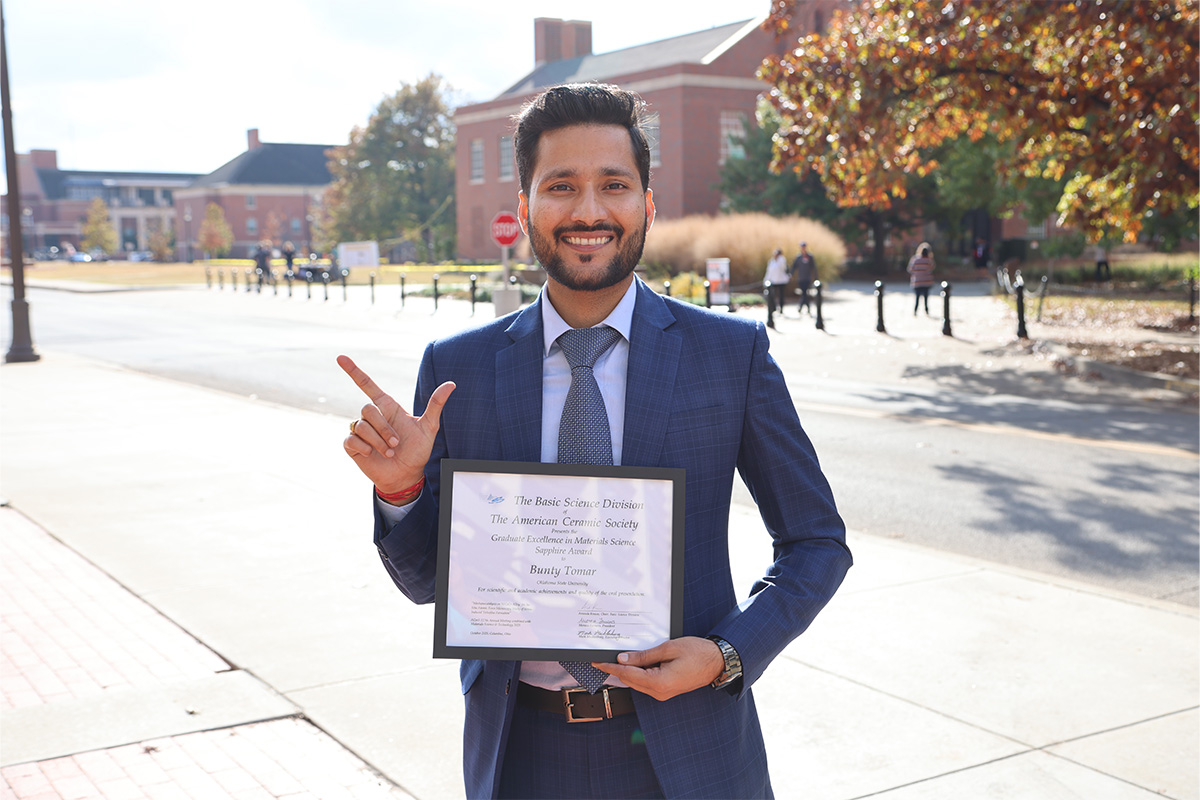
Students in the College of Engineering, Architecture and Technology at Oklahoma State University have proven themselves adept in the pursuit of innovative research.
This includes students gaining such a level of expertise that they become recognized among their peers for national and international honors. Bunty Tomar is an example of a student whose passion and determination have led to him being recognized for his research prowess.
Tomar, a graduate research assistant in the School of Mechanical and Aerospace Engineering, was honored with the Graduate Excellence in Materials Science Sapphire Award from the Basic Science Division of The American Ceramic Society – a prestigious industry award for emerging scholars.
“Receiving the Graduate Excellence in Materials Science Sapphire Award was an extremely gratifying experience,” Tomar said. “Being recognized among a global pool of researchers felt truly rewarding, and seeing my photo featured on the conference slide screen throughout the event made the moment even more special.”
He added that having the past couple years' worth of work being validated by an organization as prestigious as The American Ceramic Society is one of the most meaningful recognitions he has received so far in his academic journey.
Pushing the boundaries of extreme-environment materials
Tomar’s research focuses on designing advanced materials capable of performing in extreme environments. This includes conditions with extreme heat, harsh mechanical loading or severe wear.
His work also delves into energy-efficient and low-temperature manufacturing techniques, which are growing in importance in materials engineering. This innovation was recently published in the prestigious Nano Letters Journal.
He gave an award-winning presentation over novel approaches in generating protective coatings using only ambient air, or the air surrounding an environment.
“In my presentation, I discussed how we are triggering the catalytic properties of multicomponent alloys using external stimuli to generate wear-resistant, carbon-based coatings directly from ambient air,” Tomar said. “In simple words, we are converting air into wear-resistant carbon films.”
CEAT supportive environment leads to success
Tomar credits the mentorship and support he receives within CEAT, especially from Drs. Pranjal Nautiyal and Ritesh Sachan.
Among the welcoming and fulfilling experiences he has had in CEAT is the ability to tap into a strong collaborative culture within his lab. This leads to new and innovative ways to make discoveries through research.
“My mentor Dr. Nautiyal has been very supportive always and our great collaborative lab environment has helped me throughout the journey,” Tomar said. “New and less researched topics are always more interesting for us.”