

OSU graduate student team wins national Data4Good Analytics competition
Tuesday, February 17, 2026
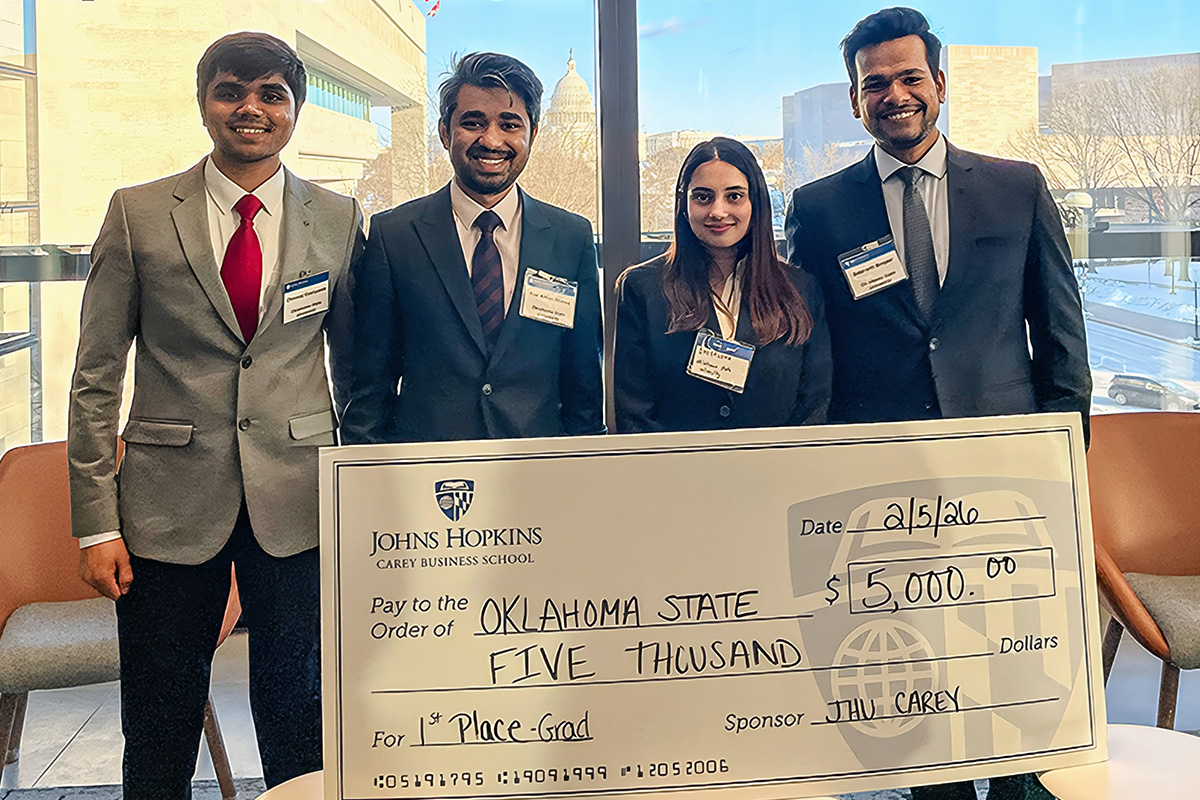 From left: Chinmay Deshpande, Kazi Arman Ahmed, Dheerusha Tiwari, Siddharth Birajdar
Oklahoma State University graduate student Kazi Arman Ahmed and his team captured first place at the Data4Good Analytics national competition, hosted by the Johns Hopkins University Carey School of Business. Ahmed, a master’s student in industrial engineering and management, teamed with Siddharth Birajdar, Chinmay Deshpande and Dheerusha Tiwari — all graduate students in business analytics and data science — to secure the win. The OSU team outperformed finalists from the Georgia Institute of Technology, Purdue University and the University of Washington to earn the national title.
The national competition drew more than 1,100 participants from 105 universities, forming 295 teams. After multiple rounds of competition, OSU emerged as the overall winner.
The Data4Good Competition challenges undergraduate and master’s students to solve real-world social problems using data analytics and artificial intelligence. This year’s case focused on developing analytics pipelines to improve the factual reliability of AI-generated educational responses.
Ahmed and his team developed a novel hybrid classification pipeline with evidence-adaptive routing to improve the detection of incorrect or misleading AI-generated responses. Using a dataset for around 21,000 educational interactions, the team built an end-to-end machine learning pipeline in Microsoft Azure, integrating semantic classification, grounding assessment and natural language inference verification.
Their hybrid model achieved a 98.91% contradiction recall rate and significantly reduced the false negative rate compared to leading single-model approaches, a critical improvement when identifying high-risk misinformation in educational contexts.
“This competition allowed us to build a complete end-to-end machine learning pipeline in Azure, from data exploration to real-time classification of AI-generated responses, which was an incredibly valuable experience,” Ahmed said. “I am extremely proud of our team. We worked day and night, experimenting, failing and refining our models until we found the best solution. Everyone pushed each other to do better, and that collaboration is what ultimately made this achievement possible.”
As generative AI tools continue to expand in education, ensuring factual accuracy has become a pressing concern. Ahmed and his team’s research addresses the growing risk of AI-generated misinformation by developing automated systems capable of verifying the reliability of educational content. His team’s success at the national level highlights OSU’s leadership in applied artificial intelligence, data analytics and innovative problem-solving.